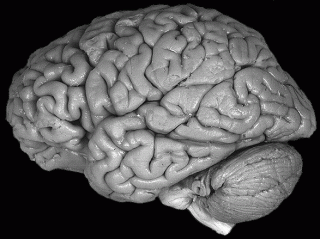
The human brain
does not automatically go into a steady decline as we age. A variety of
new studies have found that simple lifestyle choices can help to keep
your mind sharp throughout a lifespan. A January 2014, from
Germany found that the aging brain may work ‘slower’ as we age, but
that cognitive abilities do not necessarily decline as we age.
The German researchers believe that the older brain has the potential to progressively hold more and more knowledge, and wisdom,
with age. The progressive increase of data may cause the older brain to
process all the information a bit more slowly, but ultimately continue
to become more intelligent with age.
A University of California San Francisco study (link is external) from
2009 titled, “Staying Sharp: New Study Uncovers How People Maintain
Cognitive Function In Old Age” also found that cognitive function
doesn’t always decline with age. The researchers examined what factors
made the people whose cognition stayed sharp different from those who lost some of their abilities over eight years.
"Some of these factors such as exercise and smoking
are behaviors that people can change. Discovering factors associated
with cognitive maintenance may be very useful in prevention strategies
that guard against or slow the onset of dementia,"
Alexandra Fiocco, PhD, of UCSF said. "These results will also help us
understand the mechanisms that are involved in successful aging."
Over the years of researching for The Athlete’s Way (link is external) I have come up with four simple ways to boost brain power for your lifetime.
4 Simple Ways to Boost Brain Power for Life
- Aerobic Exercise: People who exercise moderately to vigorously just once a week are 30 percent more likely to maintain their cognitive function than those who do not exercise at all.
- Cognitive Training: Memory, reasoning, and speed-of-processing exercises create a winning combo for cognition.
- Don't Smoke: Non-Smokers are nearly twice as likely to stay sharp in old age as those who smoke.
- Maintain Social Networks: People working, volunteering and maintaining close-knit human bonds are 24 percent more likely to maintain cognitive function in late life.
A study (link is external)from
December 2012 confirmed, yet again, that aerobic exercise dramatically
improves aspects of cognitive function such as task switching, selective
attention, and working memory. Studies in older adults reviewed by the
authors consistently found that fitter individuals scored better in
mental tests than their unfit peers.
Both the updating of working memory and the volume of
information which could be held in working memory was better in fitter
individuals and those put on an aerobic exercise regime.
In older generations, the evidence for improvement in
cognitive function through aerobic exercise is monumental. Cognitive
functions related to implicit memory—skills that we do without
consciously thinking about them—are automatically improved through
physical activity and practice. For example, researchers found that
mental tasks relating to activities such as driving, were dramatically
better in older people who remained aerobically active.
I have written a wide range of Psychology Today blog
posts about how physical activity improves brain function. Please see
the end of this post for additional reading on this topic.
Small Amounts of Cognitive Training Pay Huge Dividends
Dr. George Rebok, who was the lead author of the study
said, "Showing that training gains are maintained for up to 10 years is a
stunning result because it suggests that a fairly modest intervention
in practicing mental skills can have relatively long-term effects beyond
what we might reasonably expect.”
Those in the memory training group were
taught strategies for remembering word lists and sequences of items,
text material, and the main ideas and details of stories. Participants
in the reasoning group received instruction on how to
solve problems that follow patterns, which is useful for tasks such as
reading bus schedules or completing order forms. Individuals who
received speed-of-processing training participated in a
computer-based program that focused on the ability to identify and
locate visual information quickly, which is useful when looking up phone
numbers or reacting to changes in traffic when driving.
One More Reason to Never Start Smoking... Or To Quit

According to Charles DeCarli, MD, with the University of California at Davis in Sacramento, "People with diabetes in middle age lost
brain volume in the hippocampus (measured indirectly using a surrogate
marker) at a faster rate than those without diabetes. Smokers lost brain
volume overall and in the hippocampus at a faster rate than
non-smokers."
Social Networks Improve Cognitive Function.
Katja Pynnönen, a Ph.D. student from the University of Jyväskylä, Department of Health
Sciences in Finland explains, "The health-enhancing influences of
social activity may be partly explained by better mobility among persons
who are socially active. Moreover, social activity may maintain
mobility and thus decrease mortality risk, as many social activities
also include physical activity."
“Good cognitive functioning and having less depressive
symptoms seemed to be prerequisites for social activity. Thus, it is
important to recognize and take into account those older people who
have memory problems and are melancholy, and may need extra support to
participate in social activities," says Pynnönen.
Conclusion: Daily Habits Impact Cognitive Function Throughout Your Lifespan

If you'd like to read more on this topic please check out my Psychology Today blog posts:

Need To Boost Your ClickBank Commissions And Traffic?
ReplyDeleteBannerizer makes it easy for you to promote ClickBank products with banners, simply visit Bannerizer, and grab the banner codes for your picked ClickBank products or use the Universal ClickBank Banner Rotator Tool to promote all of the ClickBank products.