Nigerian
central bank Governor Godwin Emefiele is losing the battle to prevent
the naira from going the way of other oil-dependent currencies.
After
imposing trading restrictions in February to prevent dollars from
fleeing the economy, importers have been unable to pay suppliers, a
thriving black market has sprung up in foreign banknotes and teachers
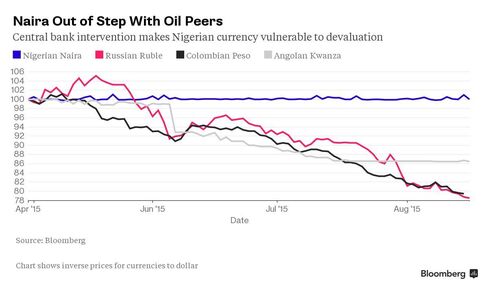
have gone unpaid. The naira has been stable over the past six months
since the central bank introduced regulations to halt a 20 percent
decline in the currency in the 12 months through Feb. 12 to a record low
of 206.32 per dollar.
That’s heaping pressure on the authorities
to ditch the rules and let the naira weaken alongside Russia’s ruble,
Colombia’s peso and Norway’s krone. Forwards prices suggest the currency
of Africa’s biggest oil producer will tumble 15 percent within six
months and 25 percent over the next year.
“Their
currency is still very overvalued and so they’re going to remain under
pressure to allow it to depreciate,” said Gareth Brickman, an analyst at
Stamford, Connecticut-based ETM Analytics. The central bank has fought
depreciation “tooth and nail, every step of the way,” he said.
Emefiele,
54, has said the exchange rate is “appropriate” and argues that
allowing it to weaken would stoke inflation in a country that imports
almost all its manufactured goods. The strong currency and a scarcity of
dollars are hurting growth, which the International Monetary Fund
estimates will be 4.8 percent in 2015, less than half the average over
the past decade.
Traders are wagering Emefiele will have to change
tack and abandon efforts to crack down on speculators. He bolstered the
rules after a strategy of burning through foreign reserves failed to
stop the naira sliding.
Devaluation Forecasts
ETM’s
Brickman predicts the central bank will be forced to devalue the
currency by about 10 percent by year-end to 220 per dollar, from 199.25
at 12:08 p.m in New York on Tuesday.
Currency
trading has “dropped dramatically” under the new rules, said Craig
Thompson, a broker at Nyon, Switzerland-based Continental Capital
Markets SA. “It’s a fraction of what used to go through.”
The
trading curbs, together with the more than 50 percent drop in oil prices
since mid-2014, are weighing heavily on Nigeria, which relies on crude
for almost all its foreign earnings. Banks are increasingly wary of
lending to individuals and Nigeria’s main stock index has dropped 16
percent since the start of April, matching the decline in the whole of
2014.
Ibrahim Mu’azu, a spokesman for Nigeria’s central bank,
defended its currency policy and said authorities would meet companies’
legitimate demand for foreign exchange.
Scrapping the rules is all but inevitable to many traders, making a weaker naira an obvious bet.
Standard
Chartered Plc, which gets more than half its revenue from emerging
markets, predicts a decline to 222 by year-end, while Goldman Sachs
Group Inc. sees it falling to about 230. Forward prices compiled by
Bloomberg signal levels of 228.15 in six months and 248.5 in a year.
Emefiele,
a former chief executive officer of Zenith Bank Plc -- Nigeria’s
second-biggest lender by market value -- isn’t the only African policy
maker trying to protect his currency against the drop in oil.
Angola’s
kwanza, which has slumped 23 percent in the past year, has been little
changed this month as the nation props up the exchange rate by spending
reserves and rationing access to dollars.
As with the naira,
that’s just storing up losses for the future, said John Ashbourne, an
Africa economist at London-based advisory firm Capital Economics Ltd.
He
sees the naira falling as much as 8 percent to 210-215 per dollar and
the kwanza losing up to 15 percent of its value by year-end. China’s
yuan devaluation this month has increased pressure on their central
banks to devalue, Ashbourne said.
“The currencies were both too strong before,” he said. “They’re still too strong.”


No comments:
Post a Comment